
Wednesday, January 16, 2019
"Too Late for Tears" (1949)
There's an old axiom in storytelling: the better the villain, the better the tale. This fascinating little noir has a doozy of a femme fatale at it's core. Played by the raspy voiced Lizabeth Scott, it involves a restless woman stuck in a lackluster marriage to husband Arthur Kennedy. Quite by happenstance they find a satchel of money, so much money that they figure it can only be ill gotten gains. Sure enough the lowlife who's missing his cash, Dan Duryea, shows up and he's not happy. The plot only gets more twisted and tangled (and deadly) from there. Scott and Duryea were mainstays of the genre and they make the backstabbing and double-dealing look easy. Add to the intrigue an old friend of Kennedy's (Don Defore) who may or may not be what he seems and you've got a nifty grab bag of murder and mayhem.


Tuesday, January 15, 2019
"Bus Stop" (1956)
This amiable film adaptation of William Inge's successful play was turned into a star vehicle for Marilyn Monroe at the height of her popularity. It proved that under all that cleavage and peroxide there really was an actress of some talent. Nevermind that her insecurities and demons made her a difficult handful while filming and that the performance was created in the editing room. The proof is on the screen. Her undeniable star presence is in full throttle. She's a self described 'chanteuse' playing in rowdy Southwest saloons working her way cross country to that big break in Hollywood. She collides with a bumpkin bronco rider from Montana in town for the big rodeo (Don Murray, who manages not to make a fool of himself given he does a lot of whooping and hollering). For this cowboy it's love at first sight; for her, not so much. The second half of the film is set in the stagebound title location where they (of course) resolve their differences and ride off into the sunset, albeit on a bus. The notable thing about Monroe's performance here is that she's working a convincing accent vastly different from her usual breathy, ditzy delivery. It's clearly patterned on the great Kim Stanley who created the role on Broadway. You can hear Stanley's slurry, drawling cadences in Monroe's mimicking. Grand larceny that works. Rounding out the cast are two dependable character actors as the sparring couple's best friends, Arthur O'Connell as Murray's ranchhand cohort and Eileen Heckart as Monroe's waitress pal. The widescreen direction is by Josh Logan.


Saturday, January 5, 2019
"Harriet Craig" (1950)
If you're one to believe the scandalous tell-all book "Mommie Dearest", the one where daughter Christina Crawford completely trashes the life, career, and memory of her beloved screen icon mother Joan Crawford, then this is the movie for you. Joan's character here comes closest to the frightening gorgon depicted in that hatchet job and the subsequent camp-fest film adaptation starring the go-for-broke performance by Faye Dunaway. She's an overbearing domestic control freak living in the suburbs. Her only motivation is to have a spotless house and perfect marriage, no matter the cost. If she has to double-cross her devoted cousin (a sincere K.T.Stevens), terrorize her housekeepers (Viola Roache, Ellen "Grandma Walton" Corby), or deviously manipulate her unsuspecting husband (Wendall Corey), so be it. It's the appearance of the ideal upper middle class life she craves and, goddamit, she'll stop at nothing to get it. Crawford is fascinating to watch, never shying away from being totally unsympathetic. You hate this harridan but you can't stop watching, wondering what jaw-dropping shenanigan she'll pull next. This is melodrama served up piping hot with a healthy side of kitsch to boot. Like Crawford's wardrobe, so gawdawful they look like rejects from a Charles Busch show. Crawford's roles in the 1950's would get increasingly campier as her looks hardened, the eyebrows and cheekbones getting sharper and more brittle. Was it the best Hollywood could offer an aging star at that time? Who knows. But Crawford sunk her teeth into whatever she was given and she owned the screen whatever the vehicle.


Wednesday, January 2, 2019
"Woman on the Run" (1950)
A great example of the best kind of film noir: simple tight plot, quick smart dialog, edgy suspense and a twisty plot all set amid a gritty urban setting. Ann Sheridan, looking like the love child of Lucille Ball and Talullah Bankhead, is the title dame. Her estranged husband (Ross Elliot) witnesses a mob killing and goes on the lam for fear he'll be the next mark for what he saw. She tries to find him while the cops tail her, they need his testimony. There's also a handsome reporter in tow (Dennis O'Keefe) trying to bag the big story, plus the real killer. No wonder she's on the run! But the best reason to see the picture, hands down, is the fantastic use of real locations. The film has Sheridan traipsing all around San Francisco, up and down the hills, around famous landmarks, and thru the crowded streets and throngs. It's a perfect visualization of that city at mid-century. If you love The City by the Bay, take a stroll thru a bygone tour of the way it looked back then in superb black and white, a snapshot that surely no longer exists.


Tuesday, October 9, 2018
"Carmen Jones" (1954)
In the early 1940's Oscar Hammerstein took Bizet's celebrated opera "Carmen" and adapted it for the Broadway stage, shifting it to modern times and using an all black cast. It took Hollywood over a decade to bring it to the screen. This is a faithful, Technicolor version. While it's great to see a bigscreen "A" picture about people of color, especially considering when it was released, Hammerstein's lyrics are a tad icky, using a white man's take on black patois, songs like "Dat's Love", "Dere's a Café on the Corner", "De Cards Don' Lie", etc. That aside, there's no denying the power of those timeless tunes. What's better is the grand larceny Dorothy Dandridge gets away with here. She steals the entire movie, as she rightly should in one of the great femme fatale roles of all time. Carmen is sexy, flirty, wily, opportunistic, and downright mean, sometimes all at once. But Dandridge, seductively decked out in tight skirts, peasant blouses, and gypsy hoop earrings, is such a refreshing one-eighty from all those servant roles we had seen black women playing for decades, you can't help but be captivated. No wonder her love interest, here played by an earnest, if slightly bland, Harry Belafonte, falls for her heavily. What a tragedy that this gifted actress went on to so few other starring parts (and a too early demise). Other standouts: a dynamic Pearl Bailey in the second female lead as Carmen's best friend, belting out a big band number along with a young Diahann Carroll as her cohort. And if you're a fan of great title sequences, this is the first of many by the groundbreaking Saul Bass, it's graphic, simple, and elegant.


Sunday, October 7, 2018
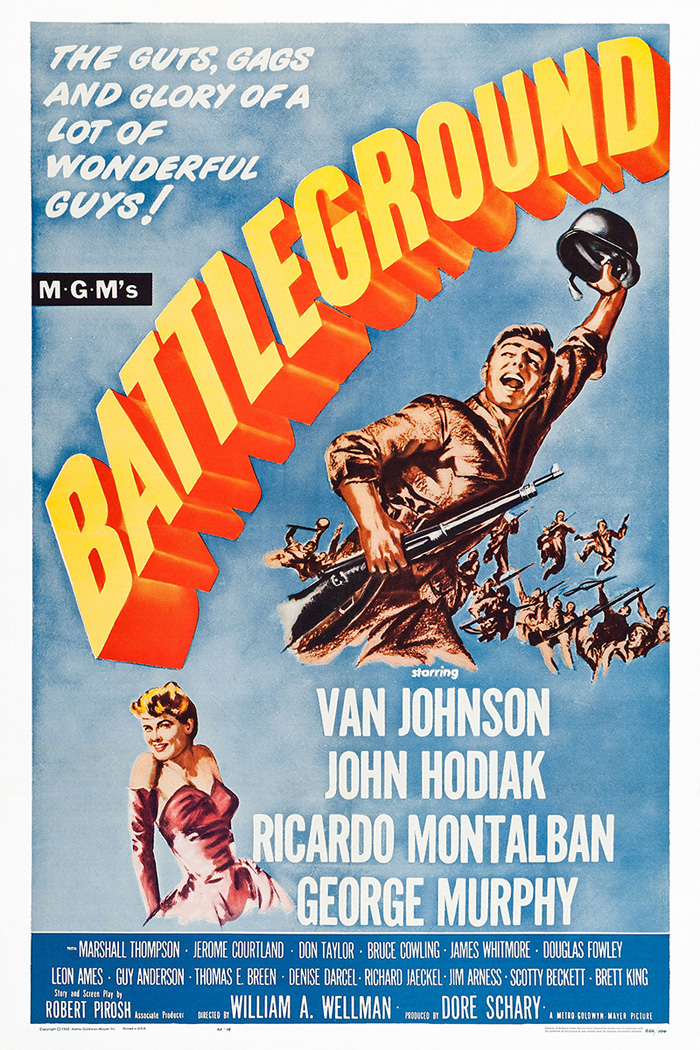
"Battleground" (1949)
By the end of the 1940's it seemed the country was world weary of World War II movies. But this story of one squadron during the Battle of the Bulge, based on the real 101st Airborne Division, was a huge success. It was probably because it eschewed the rah-rah boosterism of all the films made during the war, the ones that tried, successfully, to show why we were fighting and gosh-darn-it that we could win. A new spin on the war picture was needed. So director William Wellman and Oscar winner for Best Screenplay, Robert Pirosh, instead chose to depict the daily soul-sapping grind of the lives of the soldiers. The inedible food, the sleepless nights, the fierce cold and frostbite (it takes place in the harsh winter of 1944-45 in the French countryside), and the psychological toll of knowing you could die any moment, are all vividly brought to life by an all-star cast of great actors. Van Johnson, John Hodiak, Ricardo Montalban, James Whitmore, Leon Ames, Richard Jaeckel, all get moments to shine. Yes, there's still a bit of the cliché melting pot idea here that was so prevalent in many WWII flicks, you know, all the American archetypes pulling together to vanquish The Evil Enemy, but here it doesn't seem forced. The film has a nice documentary feel too as it follows the men on their grueling cross country trek. It helps that some actual footage of the battle is interspersed to nice effect.

Thursday, October 4, 2018
"The Snake Pit" (1948)
Olivia de Havilland goes for broke in her Oscar nominated performance as a beleaguered woman suffering a nervous breakdown and enduring lockup in a mental hospital. It probably can't be stated how shocking this picture's inside look at life in a looney bin must have been for audiences of that time. Given this was a Hollywood depiction, it was probably sanitized somewhat, but it's still a disturbing peek into the daily hell of being surrounded with crying, screeching, gibbering, unpredictable patients. De Havilland eschews any pretense of looking like a star here, stripped of makeup, frowzy and disheveled, she does a fine job of showing us a personality disorder where everyday is lived on the knife edge between normalcy and insanity. If the therapy and 'solution' to her psychological problem are a little too pat (she's helped by a kindhearted doctor, Leo Genn), chalk that up to the film being a primer on mental help therapies for the uninitiated viewer. Director Anatole Litvak does an admirable job of juggling the soap opera and horror elements, bringing it all home to a satisfying note of closure and heart.


Subscribe to:
Posts (Atom)