Sunday, April 1, 2018

Sunday, February 25, 2018

"City of the Dead" (1960)

An eerie little chiller from the early 1960's that looks ahead to other genre fare of that decade like "Dark Shadows" and "Rosemary's Baby". A young co-ed (Venetia Stevenson) is doing her term paper on the New England witchcraft of the 17th Century. Her professor (Christopher Lee) suggests she visit his hometown and stay at the inn of an old friend. Well, when the professor is Christopher Lee you don't have to be a genius to see that he's not sending her to a lovely tea social at the local library. This town is Spooky City. And the inn's proprietress (Patricia Jessel) is even creepier. Maybe there's a connection to this town and a coven of witches way back when,  but I'll avoid any spoilers. Clearly the whole picture was done on a shoestring budget but that works to it's advantage. The entire town is created with sets, the requisite fog, and shadows. Director John Moxey keeps it all atmospheric with some well-timed scares along the way. There are even some parallels to Hitchcock's "Psycho" that debuted the same year. A worthwhile gem to discover, even better you can see it on YouTube here.


Thursday, February 8, 2018

"42nd Street" (1933)

This backstage musical trots out every hoary cliché in the book, except this is the movie that invented all those clichés in the first place. The insanely driven director (Warner Baxter) who's teetering on killing himself from overwork, will his latest show push him over the edge? The wise cracking chorinnes (Una Merkel and Ginger Rogers) struggling to make ends meet who'll take any man or bit part, whichever comes first. And, best of all,  the naive ingenue (Ruby Keeler) fresh off the farm who has to take the lead on opening night when the aging star (Bebe Daniels) breaks her ankle. Even tho the pace and dialog are snappy with that sassy New York patois Warner Brothers made famous in gangster pictures, it's really the knockout musical numbers, staged by choreographic whiz Busby Berkely that make this a groundbreaking film. It's almost a misnomer to call what Berkeley does here choreography, he's basically using human bodies to create graphic shapes that swirl and undulate, surely groundbreaking for it's time. Yes, the story is all cornball, and Keeler's acting is wince causing, but it's still fun Hollywood history and a must see.

Monday, December 4, 2017

"The Spirit of St. Louis" (1957)

Hollywood's telling of the first transatlantic solo flight by pilot Charles Lindbergh in 1927 was a colossal bomb when it was released. Maybe it was because star Jimmy Stewart was way, way too old to play the historic figure (Lindbergh was 25 at the time of the achievement, Stewart was 47), or maybe Lindbergh's luster had faded because of his pro-Nazi stance during WWII, too recently familiar to an Eisenhower-era American public. Whatever the reason, a fresh look now shows this to be an slick and entertaining history lesson. Credit the iconic Stewart for shouldering most of the picture in the tight confines of the titlular flying machine's cockpit. His natural gifts for empathy and facial expression put the performance over (he pulled off much the same feat in Hitchcock's "Rear Window" a few years before). It helps that he has a sprightly script by director Billy Wilder that is filled with a number of flashback scenes leading up to the big flight that sparkle with his patented witty inflection.
He manages to fill the story with edge-of-your-seat suspense despite the fact that we know the ending...SPOILER ALERT: Lindbergh lands.

Thursday, August 24, 2017

"Marked Woman" (1937)

Warner Brothers was the studio for gangster pictures in the 1930's. Tough, realistic, violent, and fast paced they were hard knuckle entertainments and were often based on the real crime stories of the day, "ripped from the headlines"scenarios. This fine entry was based on the takedown of underworld crime boss Lucky Luciano by a group of women who worked in his prostitution ring and who would turn state's evidence against him. Strong-willed Bette Davis is leader of the "hostesses" who run up against the nasty kingpin played by Eduardo Cianelli. She teams up with the earnest DA, Humphrey Bogart, who plays against his usual bad guy type, to bring down the heavy when her innocent younger sister (Jane Bryan) gets in too deep with him. Davis is just great here, feisty and resilient. It's refreshing to see a woman protagonist in this usually male-dominated genre. And her scenes with Bogart play like two fine tennis players volleying that rat-a-tat dialog between them. The gritty direction is by Lloyd Bacon with some uncredited help by Michael Curtiz.

Tuesday, August 22, 2017

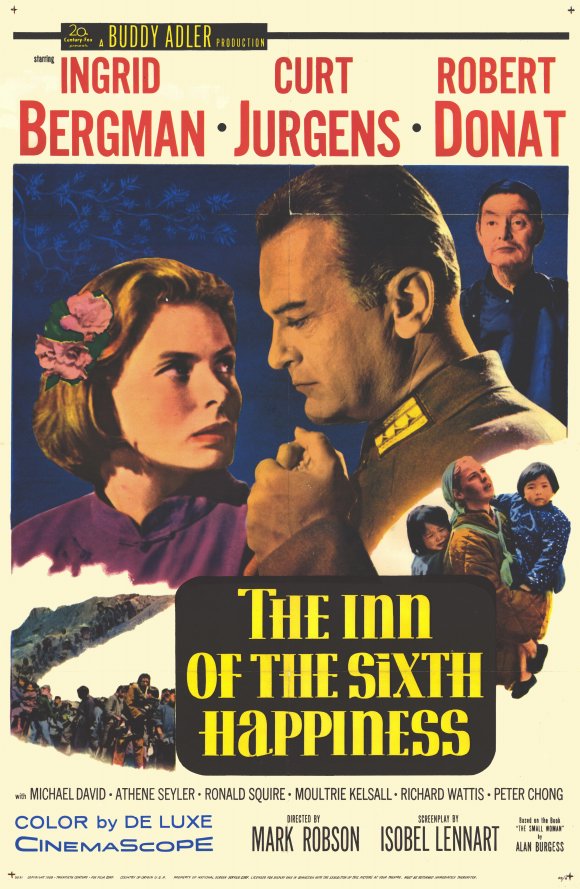
"The Inn of the Sixth Happiness" (1957)

By all measure of reason, this movie should be unwatchable. But damned if it doesn't suck you in and jerk your tears from one end of the screen to the other. A headstrong youngish British woman (Ingrid Bergman) makes it her heart's desire to become a Christian missionary in 1930's China during the Sino-Japanese war. This despite the fact that she has no training or money to get there. But get there she does. She signs on to work for an elderly missionary woman (Athene Seyler) in a remote northern province who runs a dilapidated inn. With pluck and hard work they begin to turn the place around and to help the local folks and travelers, all the while teaching the word of Christ. As the war heats up and the Japanese infiltrate the territory, Ingrid has to get one hundred--yes, one hundred-- Chinese orphans in a treacherous overland trek to safety. Missionaries, orphans, and a white hero that saves the third world...sound icky? Think again. Bergman's performance is so endearing and she imbues the character with such passion she makes the whole movie. She makes you forget some other questionable casting issues too, like her romance with a half white, half Chinese military officer played by Curt Jurgens and her winning over of the local mandarin,  Robert Donat in his last film role. You could never get away with this white-person-in-native-role business today. If both actors didn't give such sincere performances in their almond eyed makeup you'd be throwing fried rice at the screen. Yeoman director Mark Robson doesn't go in for any flashy direction. He knows where to put the camera to tell the story in solid script by screenwriter Isobel Lennart.  It's a testament to the filmmakers that the whole thing was shot in England! With a nice score by Malcolm Arnold.

Friday, August 4, 2017

"Seven Brides for Seven Brothers" (1954)

The poster bills it as "MGM's Love Making Musical!" They weren't lying. This is one of those movie premises that on the surface seems innocent enough, but when you really give some thought to what's going on you clearly see what the filmmakers were trying to slip  by the buttoned-down sensibilities of the 1950's American public (and the censors). Seven hearty red-headed mountain men, all brothers, in the pioneering days of the Oregon territory, fall in love, woo, and marry seven women from the nearby town. Let's be clear, though. They're main motivation is that they're pent up. Really pent up. Something awful. And they need...well, you know. There's a robust swagger in this musical that differentiates it from most of the glossier MGM fare. The groundbreaking choreography, by Michael Kidd, is almost purely acrobatic, giving the proceedings a decidedly lustier feeling. The justly famous barn raising sequence where the brothers are flirting with the girls and trying to fend off local suitors is a thrilling showstopper. A lot of the songs in the fine score by Johnny Mercer and Gene de Paul have a big, expansive Copland-esque feel to them. And when they're sung by the full throated baritone of Howard Keel, who's the eldest brother, and the lovely trilling Jane Powell as his intended, it's musical ear candy. But back to the sex. There are two hot scenes in underwear, in one the brothers roust about only in their longjohns, the sexiest bunch of ginger lumberjacks ever put on film, and in another the girls have a whole number wearing only their petticoats and super cinched corsets. And let's not leave out the song and dance number where the brothers are pining for their cloistered girl crushes while they're synchopatedly swing their, ahem, axes. Look for a young Julie Newmar (here billed as 'Julie Newmeyer') as one of the brides. The direction is by Stanley Donen. Filmed in Cinemascope.