
Tuesday, October 9, 2018
"Carmen Jones" (1954)
In the early 1940's Oscar Hammerstein took Bizet's celebrated opera "Carmen" and adapted it for the Broadway stage, shifting it to modern times and using an all black cast. It took Hollywood over a decade to bring it to the screen. This is a faithful, Technicolor version. While it's great to see a bigscreen "A" picture about people of color, especially considering when it was released, Hammerstein's lyrics are a tad icky, using a white man's take on black patois, songs like "Dat's Love", "Dere's a Café on the Corner", "De Cards Don' Lie", etc. That aside, there's no denying the power of those timeless tunes. What's better is the grand larceny Dorothy Dandridge gets away with here. She steals the entire movie, as she rightly should in one of the great femme fatale roles of all time. Carmen is sexy, flirty, wily, opportunistic, and downright mean, sometimes all at once. But Dandridge, seductively decked out in tight skirts, peasant blouses, and gypsy hoop earrings, is such a refreshing one-eighty from all those servant roles we had seen black women playing for decades, you can't help but be captivated. No wonder her love interest, here played by an earnest, if slightly bland, Harry Belafonte, falls for her heavily. What a tragedy that this gifted actress went on to so few other starring parts (and a too early demise). Other standouts: a dynamic Pearl Bailey in the second female lead as Carmen's best friend, belting out a big band number along with a young Diahann Carroll as her cohort. And if you're a fan of great title sequences, this is the first of many by the groundbreaking Saul Bass, it's graphic, simple, and elegant.


Sunday, October 7, 2018
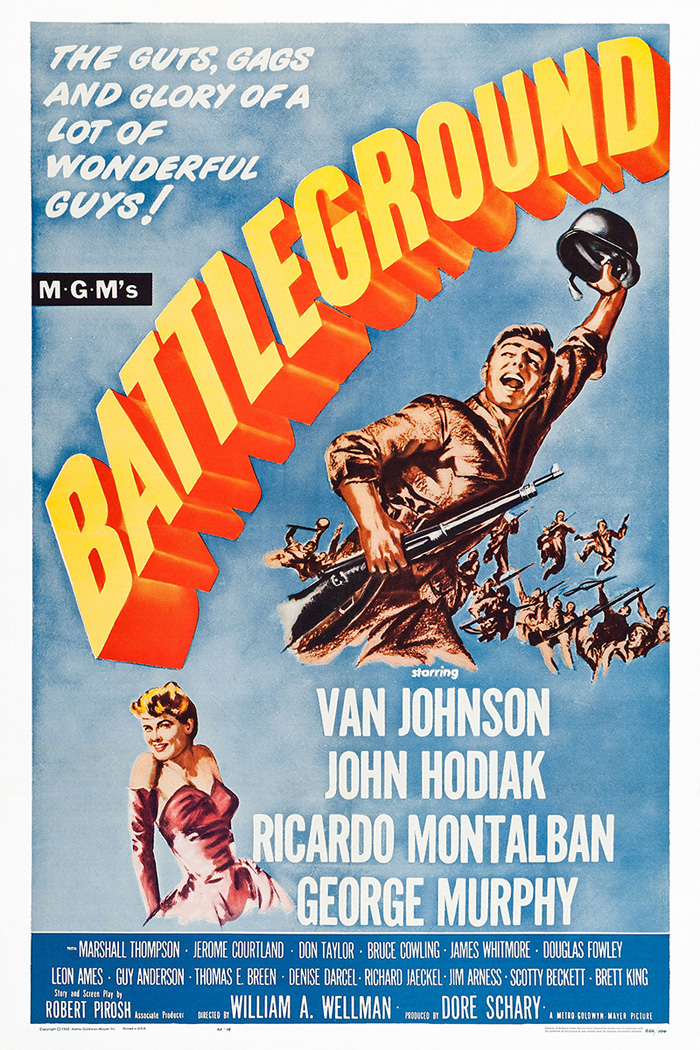
"Battleground" (1949)
By the end of the 1940's it seemed the country was world weary of World War II movies. But this story of one squadron during the Battle of the Bulge, based on the real 101st Airborne Division, was a huge success. It was probably because it eschewed the rah-rah boosterism of all the films made during the war, the ones that tried, successfully, to show why we were fighting and gosh-darn-it that we could win. A new spin on the war picture was needed. So director William Wellman and Oscar winner for Best Screenplay, Robert Pirosh, instead chose to depict the daily soul-sapping grind of the lives of the soldiers. The inedible food, the sleepless nights, the fierce cold and frostbite (it takes place in the harsh winter of 1944-45 in the French countryside), and the psychological toll of knowing you could die any moment, are all vividly brought to life by an all-star cast of great actors. Van Johnson, John Hodiak, Ricardo Montalban, James Whitmore, Leon Ames, Richard Jaeckel, all get moments to shine. Yes, there's still a bit of the cliché melting pot idea here that was so prevalent in many WWII flicks, you know, all the American archetypes pulling together to vanquish The Evil Enemy, but here it doesn't seem forced. The film has a nice documentary feel too as it follows the men on their grueling cross country trek. It helps that some actual footage of the battle is interspersed to nice effect.

Thursday, October 4, 2018
"The Snake Pit" (1948)
Olivia de Havilland goes for broke in her Oscar nominated performance as a beleaguered woman suffering a nervous breakdown and enduring lockup in a mental hospital. It probably can't be stated how shocking this picture's inside look at life in a looney bin must have been for audiences of that time. Given this was a Hollywood depiction, it was probably sanitized somewhat, but it's still a disturbing peek into the daily hell of being surrounded with crying, screeching, gibbering, unpredictable patients. De Havilland eschews any pretense of looking like a star here, stripped of makeup, frowzy and disheveled, she does a fine job of showing us a personality disorder where everyday is lived on the knife edge between normalcy and insanity. If the therapy and 'solution' to her psychological problem are a little too pat (she's helped by a kindhearted doctor, Leo Genn), chalk that up to the film being a primer on mental help therapies for the uninitiated viewer. Director Anatole Litvak does an admirable job of juggling the soap opera and horror elements, bringing it all home to a satisfying note of closure and heart.


Wednesday, September 12, 2018
"East of Eden" (1955)
John Steinbeck had a great idea for a novel, tell a modern day version of the Book of Genesis. But his plot is meandering and repetitive, there's not one but two sets of Cain and Abel! This big screen adaptation only tells the last third of the tome, probably a wise choice as it's the most plot heavy, and best part. The film is best remembered as a showcase for actor James Dean. This was his movie debut and with it he shot into the zeitgeist like a Roman candle. His emotive, raw nerve acting style was such a departure from the norm that he became the embodiment of Misunderstood Youth, a social phenomenon that would only snowball as the decade progressed into the 1960's. Today his mumbling and body contortioning seems mannered but you do end up feeling for his love-starved character, a young man who is destined to destroy his twin brother (sorry if you haven't kept up with your Bible and that's a spoiler). Raymond Massey is the stern Adam/father and Jo Van Fleet is the Eve/fallen mother who walked away with the Oscar for her coiled sinister performance. Director Elia Kazan tries some baroque camera techniques to convey the family's unbalanced dynamic; it's not always successful. But it's Dean that's the draw here, you can't take your eyes off him. It's a fleeting glimpse of what would become a Hollywood icon in just three films before his life was cut short in a tragic death.


Monday, September 10, 2018
"Dial 1119" (1950)
True fact: the national emergency call number 911 was not fully adopted across the country until the late 1960's. Until then, various numbers were used regionally, hence the title of this tight, suspenseful little noir. And there's an emergency alright: an escaped mental patient (Marshall Thompson) goes on a murder spree and finally holes up in a late night bar taking a few hostages at gunpoint. The story cross cuts between the lunatic's tormenting of these character types, learning their backstories (a washed up reporter, a prim single gal on a date with an older man, the gin-soaked floozy barfly, etc), and the cops out on the street trying to form a game plan to rescue the bunch. The film is notable for a couple of prescient observations. There's a big hulking contraption up in the corner, one of those new-fangled televisions, and the people trapped inside get to see their predicament played out on the local news in real time, a canny prediction of media circuses to come. There's also some dramatic friction with the main homicide detective and a criminal psychologist about how to deal with this loony. Again, this was way before 'profilers' and 'mindhunters' became everyday catchphrases. Look for two fun cameos also. TV's "Cannon", William Conrad, is the easygoing barkeep and Beaver Cleaver's pearl-clad mom, Barbara Billingsly, has a few deft lines as newspaper secretary.


Sunday, September 9, 2018
"Marty" (1955)
Hollywood historians often name this the first independent movie, one made outside the traditional studio system of the day. It was a huge success, maybe because it zigged while all the big films zagged. Instead of a Technicolor/Cinerama/Vistavision extravaganza, which conventional thought said "give 'em what they can't get at home on their TV", this small story went into the belly of the beast. It was a adaptation of a teleplay already aired on the small screen. Paddy Chafesky re-tooled his own work and turned out a very affecting and simple story of a lonely Bronx butcher (Ernest Borgnine) looking for love and finding it in a fellow LonelyHeart (Betsy Blair). More than just a character study, it now serves as a window into how stifling society norms used to be concerning age, singlehood, dating, and marriage. Maybe the most shocking is the out-and-out body shaming that goes on here. The two leads are constantly referring to themselves as "dogs", "fat", "plain", etc. Fun times. That said, you'll find lots of feels here. Manipulative? You betcha. But sometimes an ugly cry can be pretty too.


Saturday, September 8, 2018
"The Stranger" (1946)
Director Orson Welles would dismiss this thriller-noir as his least favorite of his pictures. Probably because there's little nuance here, in character, theme, or plot; it's a straightforward post-WII suspenser about a kindly college professor (Welles himself) who's actually a vicious Nazi war criminal hiding out in a Norman Rockwell small town. But accessible does not mean bad, and entertaining doesn't mean ignore it. The tight script works to it's advantage as a dogged investigator from the War Crimes Commission (Edward G. Robinson), get's closer and closer to revealing Welles identity secret. He's sort of a precursor to TV's "Coumbo", annoying Welles with incessant questions and snooping. Loretta Young is on hand as the unwitting fiance of the villain, she's not that bright but you need someone sympathetic in grave peril by the finale to kick up the nail-biting. There's a lot of debt owed to Hitchcock's "Shadow of a Doubt"here, another tale of a creep taking cover in Nice Anytown, USA, but that's quite okay. It brings to mind that quote from Picasso, "Good artists copy. Great artists steal."


Subscribe to:
Posts (Atom)