
Wednesday, May 15, 2019
"A Star is Born" (1937)
Before there was Garland, before there was Streisand, and yes, before there was Gaga, there was this first remake of a soapy Hollywood story that, defying all odds, works every time it's told. For the record, the original was titled "What Price Hollywood?". Other than the name change the basic plot in every version is stet: a young performer brimming with untapped talent meets and falls in love with an established star at the peek of his fame but who's on a downward trajectory involving substance abuse. He helps her make her mark and as her career skyrockets while his hits the skids. Tears and histrionics ensue. This version starring Janet Gaynor and Frederic March zips along and the economy of storytelling is refreshing if you're used the subsequent versions that were all musicalized with songs and productions numbers that pad out the action. And it's obvious why actors are drawn to these roles. The female gets to suffer nobly and stand by her man as he self destructs and the male lead has all that internalized self-imolation to pull off. Both stars here shine, March especially so. His tragic ending is particularly poignant without being hammy. This was also the first Technicolor movies to more artfully use the spectrum of shades available, more realistic shadows and tones than the garish look of color films up until that time.


Sunday, May 5, 2019
"My Sister Eileen" (1942)
Rosalind Russell was in her wheelhouse with comedic roles. They gave her free reign to display her gifts with the quick comeback, the insulting zinger, or the subtle facial expression that said it all. This screwball comedy was no exception. Adapted from a hugely successful Broadway play, she's a newspaper reporter making a new start for herself in The Big Apple. Her beautiful aspiring actress younger sister, an effervescent Janet Blair, is in tow as well. With no money but high hopes, they find a cramped basement apartment in Greenwich Village complete with an annoying landlord (George "Mr. Kravitz" Tobias from TV's "Bewitched"), and a slew of other neighborhood characters and crazies. Their place becomes a revolving door of madcap confusion. Russell tries for a job at a literary magazine and falls for the handsome editor (Brian Aherne). Snappy and delightful. Oh, and look for a fun cameo in the final scene!


Saturday, May 4, 2019
"All That Jazz" (1979)
This is a veritable salmagundi of all things Bob Fosse. The famed theatre and film director/choreographer was swinging for the bleachers here, pouring all of his signature style and themes into one big explosion of splashy and spiky entertainment. Just like the man himself there's a lot to love/hate. It's like his "81/2" but with musical numbers, a semi-autobiographical look at an artist grappling with his artistic output (or lack thereof) and his complicated relationship with the women in his life. Fosse's stand-in is Roy Schieder as 'Joe Gideon', a director of stage and screen stretching himself too thin between too many projects and using booze, pills, and sex with too many chorus girls to get him through it. It pushes him to a heart attack and the storytelling conceit of the picture is that it takes place entirely in that split second when he's on the operating table, balancing on the brink of death. His life is recounted in flashbacks during a conversation he's having with the beautiful Angel of Death, a sexy Jessica Lange. It sounds more complicated than it is. Joe is not a nice man but Schieder's performance makes you like him anyway and you can see why his ex-wife (Leland Palmer), his current girlfriend (Ann Reinking), and young daughter (Erzebet Foldi) forgive all his sins and shenanigans, they love him and don't want him to die. Death and dying is nice material for a musical, right? Well, it's the dance numbers that make this magnum opus truly great. From the opening showstopper, an open Broadway cattle call for chorus dancers, essentially "A Chorus Line" done in five minutes, to the way-ahead-of-its-time "Air-rotica" number, a slithering orgiastic hot house of sweaty limbs and torsos, it's vintage Fosse. Isolated body parts, multiple dancers in shaped formations, fingers snaps, splayed hands, bowler hats, you name it, it's here in spades. Nobody used the medium of film better to display an ownable dance vernacular. And while Fosse's work could be cool and distant, there's one small number in the middle of the movie where Rienking and the daughter do a special living room duet just for Gideon, a precious number of love and razzmatazz that's the very essence of joy in dance. You get the feeling that very joy is what Fosse strove for throughout his career.


Monday, April 29, 2019
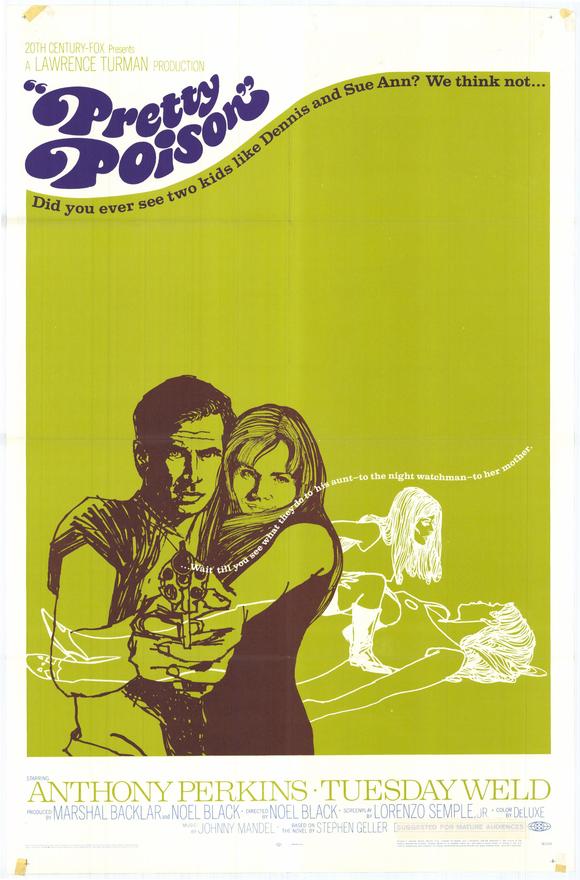
"Pretty Poison" (1968)
This odd and subversive tale of two attractive young lovers falling into a crime spree seems, at first blush, clearly aimed at the same success formula "Bonnie & Clyde" famously made the previous year, but while the former film was about the intertwining of violence, celebrity, and entertainment in our culture, this one is about something else altogether, the prickly truth that our cherished American values come with a dark side, and if we're not careful they'll rot us from within. It starts off as a kooky quasi-rom-com, a picture perfect couple meet cute at a hotdog stand (how Americana can you get?). Tuesday Weld is a sunny sweet high school drum majorette who talks on a pink princess phone in her frilly bedroom, dressed in Ann Roth's flouncy cotton swing dresses. Too cute by a mile. Anthony Perkins is the clean-cut boyish guy in button-down oxford shirts and corduroys. All good...but like so much in this movie, nothing is as it seems and before long the tone changes, things turn sinister, and you're left unmoored by the shocks that follow. This has become a sleeper cult film over the years and deservedly so, definitely one to seek out.

Thursday, April 25, 2019
"They Made Me a Fugitive" (1947)
One of those small-ish and British film noir pictures from the 1940's that shows Hollywood didn't have a monopoly on the shadowy dark currents of the genre. This one is conspicuous for its decidedly Hitchcockian feel, using one of The Master of Suspense's great themes, an innocent man wrongly accused of a crime he didn't commit who has to clear his name (see "The 39 Steps", "Saboteur", and "North by Northwest"). Trevor Howard is a former RAF pilot who falls in with a bad lot of black market racketeers in London. After a failed heist where a cop is killed, he gets blamed (wrongly) and is in hot pursuit by the authorities and his former gang members who want him dead. Along the way he gets the help from a sympathetic blonde (Sally Grey), channeling her best Linda Darnell/Lana Turner lusciousness, and romance ensues. There are some nice suspense set-pieces and a thrilling chase finale across the sooty rooftops of Londontown. Worth your time.


Monday, April 22, 2019
"Flower Drum Song" (1961)
Musical theatre aficionados rate this show as second tier Rodgers and Hammerstein, not in the same artistic league as the famed composer/lyricist team's more celebrated Big Five: "Oklahoma!", "Carousel", "The King and I", "South Pacific", and "The Sound of Music". That said, even lesser R&H works are better than most, and this screen adaptation has much to recommend. It's the story of the clashing cultural values of first and second generation Chinese families in San Francisco's Chinatown and the resulting romantic rondelay of two intertwined sets of lovers. There are a couple of nettlesome caveats however. Of the four lead actors (Nancy Kwan, Miyoshi Umeki, James Shigeta, and Jack Soo), three are of Japanese descent, Kwan being Chinese/British. Makes you think studio executives were using the abhorrent "they all look alike" excuse when casting. Does it affect the viewing of the film? Ish. But this was 60 years ago and we can't forget how groundbreaking it was to see a major Hollywood film showcasing an all Asian cast. Hell, it's still groundbreaking today (see the welcome success of "Crazy Rich Asians"), so it's a lump you have to accept to watch the film. There are also some groaner bits of dialog ("The old man had egg foo young on his face.")...really? But now the good stuff. Nancy Kwan is electric. It's criminal that she didn't go on to other leading roles. She's smart, sexy, and she slays any scene she's in. She had a dancing background so she aces her big musical numbers ("Grant Avenue" and "Fan Tan Fannie") and her leggy prancing and preening in the show's most famous song "I Enjoy Being a Girl" is scrumptious, making this number a drag show warhorse for the next fifty years. The whole production was shot on sets, even big San Francisco street scenes, so there's a stylized theatre-like quality to everything like many comedies and musicals of that era. Reliable director Henry Koster did the direction and Irene Sharaff works wonders doing umpteen variations on the cheongsam dress, but perhaps the best production touch is the snazzy, jazzy choreography by Hermes Pan, it adds a youthful modern touch to the proceedings.


Friday, April 19, 2019
"Tess" (1980)
Thomas Hardy's classic novel of the tragic life and loves of a 19th Century English milkmaid, "Tess of the D'Urbervilles", comes to the screen in this stately adaption by director Roman Polanski. The novel is still a vital part of the Western canon because it grapples with a couple of knotty themes that irk us to this day, namely the hypocrisy of religion and the grossly unfair gender roles society lays down for men and women. You won't find a more stunningly beautiful movie (it won a well-deserved Oscar for cinematography), and the production is uniformly faithful to the source material. In her movie debut, Nastassia Kinski--looking like a young Ingrid Bergman--does an admirable job in the title role. Not to damn with faint praise, but the picture is a nicely measured telling of the story. If you love the book, you'll admire the movie. So what's the catch? Well, it's one of those instances where you can't separate the art from the artist. Not Hardy, but Polanski. See, he made this movie only three years after having been notoriously banished from Hollywood (and America) for allegedly raping a thirteen year old girl. He fled to Europe and hasn't graced our shores since. And since this story directly hinges on the rape of the title heroine, a naive teenager, by an older man (sorry for the spoiler but it happens early in the story), you have to question the director's motivations here, and it will alter your perception of the film. Is it a sincere apologia for his transgressions? A misguided rationalization? Or maybe just a big F.U. to all those who damned him? You decide. Depending on your viewpoint, it may or may not help that the ad campaign's tagline was "She was born into a world where they called it seduction, not rape." See what I mean?


Subscribe to:
Posts (Atom)